For the gardener who craves flowers, I have found late fall into early winter to be the most challenging season for a frost hardy floral display. Every plant with a lick of ‘common sense’ is entering into dormancy in preparation for a long winter’s nap. Only the most ardent of bloomers would consider flowering then! It also proves challenging for garden centers who are hesitant to bring in plants for late season color at a time when no one is thinking of flowering plants. Interestingly, a great solution to this flowering dilemma is not to be found in Asia or the mountains of Europe, but in the Eastern North American woodlands. Hamamelis virginiana or Witch Hazel is a relatively common understory plant to NJ, yet it is surprising how few gardeners have come to recognize its beauty!
Witch Hazels are members of their own family of Hamamelidaceae with 2 or 3 species native to North America, one to Japan and one to China. Hamamelis virginiana is native from Nova Scotia west to Minnesota and south to Florida and eastern Texas. Perhaps some of the hesitation for gardeners stems from the common name; why buy a plant that could be aligned with witches and shaman practices? In reality, the name Witch most likely comes from the Old English wiche or wych, referring to something pliable. The stems of Hamamelis are quite pliable and young forked stems were purportedly used as divining rods in search of water! Hazel refers to the shape of the leaf, which resembles that of Corylus or Hazel. Plants were initially introduced into Europe by Peter Collinson (1694-1768) who was a fabric merchant by profession, but had a strong passion for gardening. He became friends with American plant collectors such as John Bartram (1699-1777) and realizing there was a demand for plants from across the ‘pond’, he helped to fund their plant expeditions. Collinson was also well connected with the European scientific community, including the Swiss botanist Carl Linnaeus (1707-1778) and he most likely passed along samples of Witch Hazel to Linnaeus. In 1753, Linnaeus published both the genus name of Hamamelis and the species of Hamamelis virginiana. Hamamelis was from the Greek hama, meaning together, and mela, meaning fruit. The name was based on how Hamamelis virginiana has seed capsules or ‘fruit’, flowers and next year’s buds all ‘together’ on the stems concurrently. The species epithet is in reference to the enormous colony of Virginia that initially extended north to the Great Lakes! Somewhere within the colony Bartram collected seed of Hamamelis virginiana. This species was well received by European gardeners and was long respected by Native Americans for its medicinal qualities. The oils captured from the steam of boiled stems and bark were used for reducing inflammation. Whether it was for cuts, insect bites, sore muscles, inflammation or even as an aftershave for those lacking dexterity with a razor, Witch Hazel was the cure!
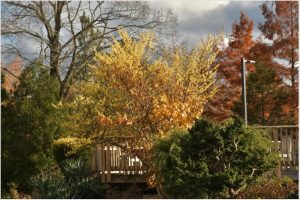
Even considering the odd time of year for bloom or the intriguing shaman reference of the name, the only true excuse a gardener should have for not planting this Witch Hazel is simple unawareness! The multistemmed plants are typically open in appearance when seen in woodlands, often reaching rather demure heights of 10-12’. However, in full sun, the plants grow much denser and taller, often reaching heights of 20’with the gently arching habit far more readily apparent, as seen at right in fall color at Frelinghuysen Arboretum. The appearance of the plant also varies by their native provenance. Those located further north are shorter in stature with larger leaves while those found in southern regions are taller, some reaching to 30’ with smaller foliage.
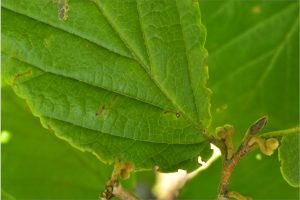
Throughout the growing season, the dark green foliage provides an attractive foil for other plants, as the obovate oregg-shaped leaves grow upwards of 6” long by 2-4” wide. Characteristically, the leaf bases on either side of the leaf petiole are mismatched, with one side shorter than the other (as seen at left). Come autumn, the foliage turns to a buttery yellow, from late October through November in NJ. The flower buds can appear singularly, but they are usually in clusters of up to 4 per floral stem or peduncle, as it is known botanically. Each cluster of buds originates from the base of the leaf, as seen at left, with the yellow flowers beginning to open come late October. They are initially masked by the golden foliage, but gradually become more apparent in November as the leaves fall (the image below shot on November 9th).
The flowers consist of 4, strap-like petals, as seen below right. Each petal is upwards of ¾” long with a somewhat crinkled appearance. Appearing near the base of the petals and alternating with the petals are 4 short and yellow pollen bearing stamens along with 4 greenish, nectar bearing stamens that are sterile. At the center are 2 highly pubescent or hairy styles that support the stigmas.
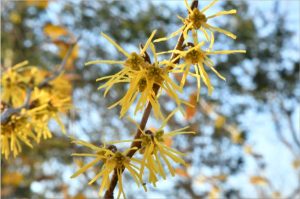
The flowers bloom for 4 weeks or longer depending on the weather conditions and release a slightly spicy fragrance. During cold weather, the petals curl clockwise into the flower in an attempt to protect the floral parts. The flowers are pollinated by gnats and bees that remain active late into the season, feasting off the nectar and sticky pollen. Interestingly, throughout the winter the base of the female carpel containing the ovary and the pollen transferred by an insect remains in a state of suspended animation and the actual act of fertilization does not occur until the following spring. The seeds slowly develop in pods that resemble a pair of puckered lips throughout the summer and fall (pictured below). Each pod holds one or two developing black seeds.
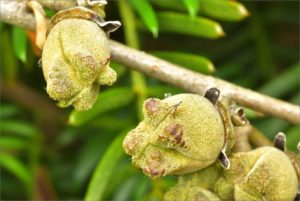
Come October, the seeds are dispersed by a mechanism called Explosive Dehiscence, whereby the seeds are literally shot out of the seed pod to distances of up to 30’! As a teenager tending the garden of one of my first ‘client’s’ , I remember one early November day eating lunch next to a Witch Hazel. The owners German Shephard was patiently sitting by my side in hopes of a handout or belly rub. All the while I kept hearing a very distinctive sound of something hitting the newly fallen leaves. The sound came in sets of two. That memory stuck with me and I know realize I was hearing those ejected seeds!
Hamamelis virginiana is not the only North American Witch Hazel blooming in late fall.
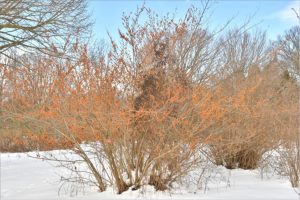
Even less known among the gardening community is the Ozark Witch Hazel. As the name infers, it is native to the Ozarks, growing from Southern Missouri through northwestern Arkansas into eastern Oklahoma. The renowned botanist Charles Sprague Sargent (1841-1927) originally described and named the plant in 1911 as Hamamelis vernalis. Sargent served as the first Director of the Arnold Arboretum, beginning in 1872 and continuing for the next 55 years until his death. He worked with landscape architects, such as the renowned Beatrix Farrand along with many nursery professionals who were all attempting to learn the many new plants coming into commerce from lands abroad. The species epithet indicates how plants can bloom around the spring vernal equinox, although some seedling selections will start to bloom in late fall and early winter. The plant is also commonly referred to as Vernal Witch Hazel. Most references still list it as Hamamelis vernalis, but in December of 2007, Frederick Gustav Meyer (1917-2006), the well-respected Director of the National Arboretum’s Herbarium from 1963-1991 reclassified the plant as Hamamelis virginiana subspecies vernalis. It is interesting to note how the Ozarks are a family meeting grounds since the subspecies and species of Hamamelis virginiana often grow a mere 20’ apart! They manage to sustain their distinct characteristics most likely through the limited overlap of bloom time.
Although rarely seen in home landscapes, I must admit the Vernal Hazel has long been a favorite of mine. A multistemmed shrub growing from 15-18’ tall, the dark green foliage followed by yellow fall color appear very similar to that of its cousin. Of course, there are exceptions and for those plants with more brilliant red or purple flowers, the fall color traditionally features attractive red overtones.
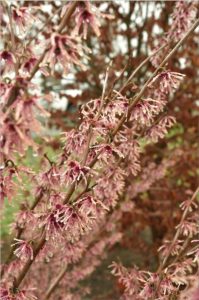
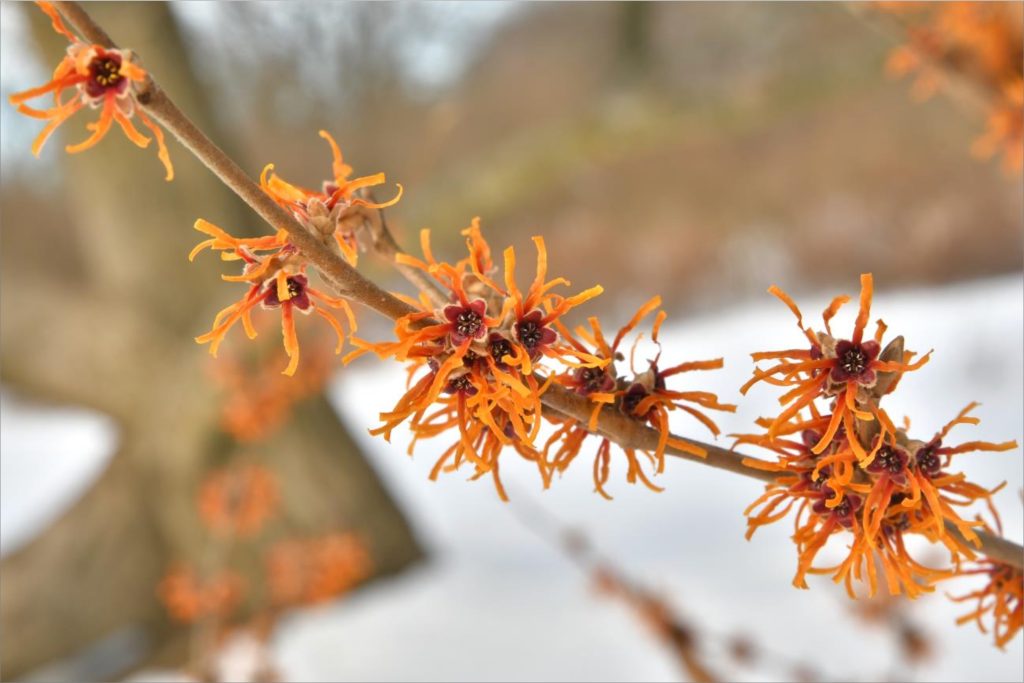
One downside with younger and vigorously growing plants is the tendency to retain the now tan foliage throughout winter. Flowering often persists for up to a month or longer, with a few plants commencing bloom in late fall while others wait until the warmth of spring. The major difference between the species and subspecies is the wonderfully sweet fragrance offered by the Vernal Witch Hazel flowers. On those ‘warm’ 35 to 40-degree days in winter, fragrance can waft a good 30’ away and is known to attract not only gardeners but a bevy of pollinators! The petals vary from red to orange (as seen below), with the occasional plant showcasing yellow or deep purple blooms! Petals are smaller than their cousin, usually ⅓ – ½” in length. However, when set against a snowy backdrop as seen above on a chilly 35° February afternoon, it provides a very impactful and well received winter sight.
The Ozark Witch Hazel has several selections that are available in the trade. ‘Red Imp’ is a readily available form with a somewhat more compact habit, growing to 8-12’ tall. It was named by Peter Dummer and Roy Lancaster at Hilliers Nursery in England in 1996. The fall color is a bright red, followed by reddish orange flowers come late February and March. It does have the annoying habit of retaining the previous year’s foliage that can obscure many of the blossoms. The cultivar ‘Kohankie Red’ was selected by the Henry Kohankie Nursery of Perry Ohio and is another mid-sized plant reaching 8’ tall by 12’ wide. I find the flowers more purple than red, as seen above left, but they are still very attractive and definitely light up the winter garden when back-lite! The flowers area also considerably larger, sporting ¾-1” long petals.
If you are lacking color and fragrance in your late fall and winter garden, these two plants can provide the
solution to your problem. At Rutgers there was a selection of Vernal Witch Hazel that consistently started to bloom at the end of December and was often still in bloom come February (pictured below), while at Frelinghuysen Arboretum a Hamamelis virginiana glows nicely against the mid-November skyline (the initial image). If you are looking for flowers for late fall through winter, look no further than your local woodlands or a trip to the Ozarks via your local garden center. Sometimes great spicy or fragrant flowered solutions really are just under our nose!
Bruce Crawford
Morris County Parks Commission