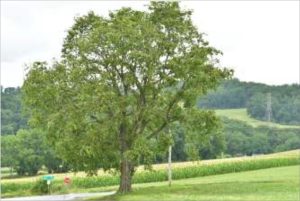
My appreciation for shade trees has certainly changed over the years. Like many gardeners, it was a group of plants I valued yet rarely used in designs or planted! Of course, perspectives changes and I am now a huge proponent of planting shade trees. I have grown especially fond of trees that can tolerate the abuses associated with tough sites and are beneficial to wildlife. Hackberry or Celtis occidentalis was a shade tree I initially learned in school, although I recall it was often maligned as a second-rate tree. Experience has since taught me different! A nice specimen of the tree is seen above amidst farmland in North Hampton County, Pennsylvania.
Celtis is a genus of woody plants with between 60-70 species found in temperate climates throughout the world. It was initially assigned to the Ulmaceae or Elm Family, and the plants certainly bear similarities in both habit and foliage to the American Elm (Ulmus americana). However, in 2009 it was shifted to the Cannabaceae or Hemp Family. The plant was named and described in 1753 by the Swedish botanist and physician Carl Linnaeus (1707-1778). Of Latinorigin, the genus name came from the Roman naturalist and army officer Gaius Plinius Secundus, who was often known as Pliny the Elder (23/24-79). He applied the name to a tree he believed it to be the famed Lotus fruit of Greek Mythology, which would supposedly create drowsiness when eaten. Perhaps owing to the edible fruits of Hackberry or for some reason unknown, Linnaeus assigned the ancient name to this tree! The species epithet means western and without doubt, the plant is certainly native to areas West of Sweden! It is actually native to a broad area of North America, stretching from New Hampshire south to North Carolina and west to North Dakota and Oklahoma. Small populations are also found in the southern reaches of Quebec and Ontario.
Throughout its native range Celtis occidentalis is found growing near streams in moist lowlands or flood plains where they can tolerate several weeks of inundation. They are also found on dry rocky slopes and bluffs. Plants are capable of growing 40-70’+ tall and 50-60’ wide with the larger specimens found where soil and moisture conditions are optimal.
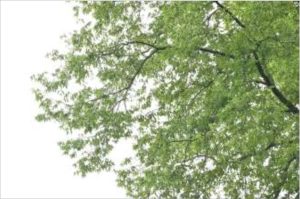
I became aware of its tough constitution when I moved to Warren County NJ where plants are found growing on limestone ledges in very thin soils yet, they also appear near wetlands in far deeper and occasionally flooded soils. It was its ability to thrive under such diverse conditions that sparked my initial interest in the tree. The habit of the tree also caught my attention (as seen in the image above in PA). Although in youth the habit is loosely pyramidal, it develops an attractive globe to arching habit as it matures. Granted, the habit may not rival the beauty of a mature Elm but it is still striking and I appreciate how the small branchlets of the outer canopy drape downward and soften the overall appearance of the plant. The hanging branchlets also allow the individual leaves to be readily observed (as seen above). The foliage is arranged alternately along the stems with each leaf measuring 2-5” long by 3” wide with a characteristically mismatched base where it connects to the petiole. Come autumn, the foliage turns a soft, buttery yellow.
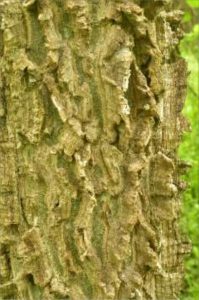
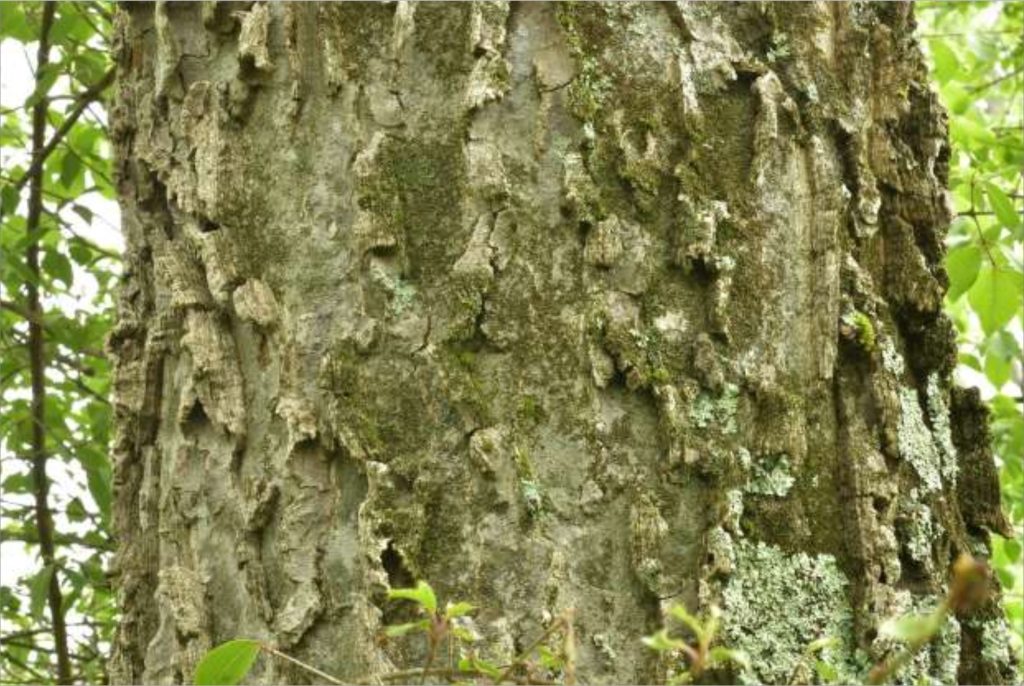
Aside from the habit, the bark is another wonderful attribute (as seen in the image above). In youth, the bark develops very pronounced, corky brown ridges that run vertically along thetrunk. The ridges can rise to 1” tall with the bark located between the ridges displaying a nice green color that is dotted with brown lenticels. Although the ‘elevation’ of the ridges diminishes with age as seen in the closing image, the bark still retains a very interesting platy and ridged appearance, providing interest throughout the winter.
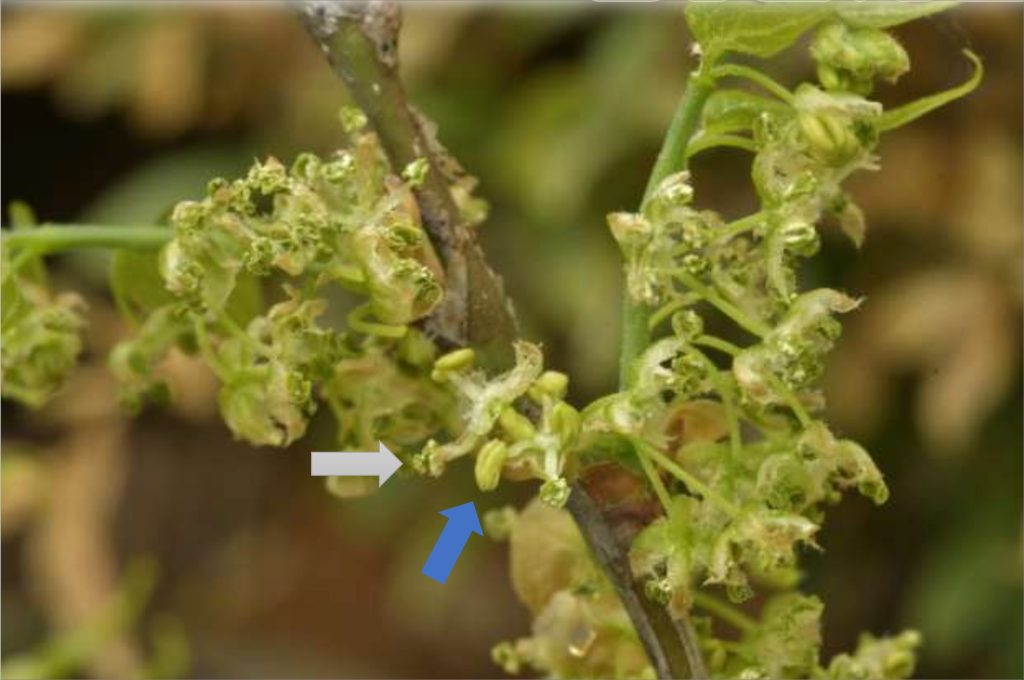
Come spring, the appearance of the light green flowers coincides with the first flush of foliage and as a result, the delicate flowers are often overlooked. The trees are primarily monoecious, meaning they produce both male and female flowers on the same plant. Occasionally, a perfect flower is produced, containing both pistils and stamens. In the image above, the anther at the tip of the blue arrow can be seen splitting open to release the pollen, while the gray arrow highlights an anther whose pollen has been shed! The flowers are ¼” wide with the male flowers appearing in clusters at the base of newly expanding branchlets. The female flowers arise at the tip of the same branchlet and appear singularly or in pairs at the base of the leaf petioles.
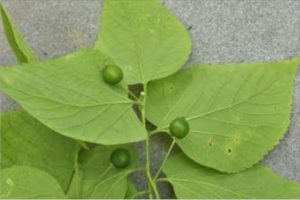
Both sexes are apetalous with only 4-6 green sepals visible around the blooms. Without any alluring petals or fragrance, the abundant pollen relies on the wind for its transfer to the stigma of the female flowers. Within several weeks, ¼” round green fruits can be seen gracing the branches (as seen at left), although they do not mature until fall when they transition to dark maroon. It is these fruits that inspired the common name of Hackberry. The European Bird Cherry (Prunus padus) bears fruit that is beloved by birds and is called Hagberry in Scotland. Noticing the resemblance of the Bird Cherry’s fruit to that of Celtis, the early settlers called the tree Hagberry which gradually transitioned to Hackberry! The fruits are botanically termed a drupe, since they contain one large seed, along with high amounts of carbohydrates, protein and fat. Not only are they eaten by birds, but were also used by numerous Native American communities, including the Apache, Dakota and Omaha who ate them seeds and all when fresh, or made them into jams or rubs to favor meats.
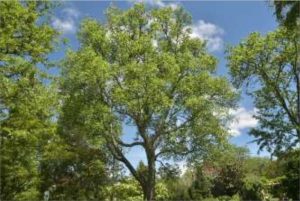
Another species native to Eastern North America is Celtis laevigata, commonly known as Sugarberry (as seen at right at Willowwood Arb). This species was described in 1811 by the German botanist and pharmacist Carl Ludwig Willdenow (1765-1812). The species name is from
the Latin Laevigātus meaning smooth and is in reference to the bark (as seen in the image at right).
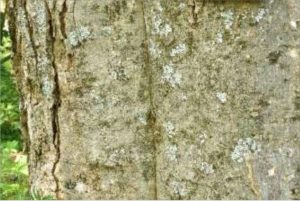
The light gray bark can still have small, wart-like protrusions but by comparison to its cousin, the bark is indeed smooth! Plants are native to Virginia south to Florida and west to Oklahoma and Texas, including some small populations in northern Mexico. The plants are often found growing in clay or silty soils along streams, although it too is occasionally found growing on rocky slopes rich in limestone.
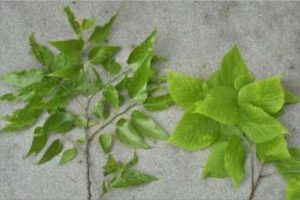
Willowwood Arboretum has a beautiful specimen growing near the parking lot that I admire every time I pull in to park (as seen above). It is very similar to its cousin and aside from the bark, the major differences are the narrower and glossier leaves along with sweeter, juicier fruits that resulted in the common name of Sugarberry! As seen in the image at right, the narrower foliage of Celtis laevigata is on the left, with that of Celtis occidentalis is on the right. Although the size and overall shape of the canopy is similar, the root systems differ between the species, with that of Celtis occidentalis growing to depths of 10-20’ while its cousin has a shallower and more spreading root system. This deeper root system makes Hackberry the preferable candidate around sidewalks and patios that are often lifted by a shallower root system. Both trees make a great addition to the Southwest corner of a home or office where it will help cool the building and reduce the expense of air conditioning. In fact, the USDA Forest Service has estimated a tree in this location will reduce the annual air conditioning expense by 30%.
They are also great candidates for placing near the curb or a patio since the act of looking under and past the canopy and trunk will make the yard appear larger! When used in pairs or lining a drive, the slightly arching canopy shapes the area between into a comforting, cathedral-like space – a concept of shade trees that took me many years to understand!
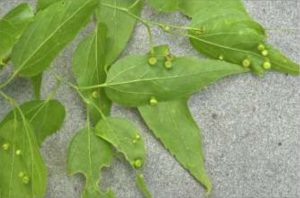
Sugarberry is hardy in zones 6-9 while Hackberry is more cold tolerant, thriving in zone 3-9. Neither are overly bothered by diseases, although both are prone to ¼” long galls formed on the leaves by small winged insects called psyllids. The galls are seen on Celtis laevigata pictured above. As the stationary psyllid nymphs (larva) suck juices out of the leaves, the leaf develops tissue around the nymph and the galls are the visual result. The nymph continues to partake of the plant’s leaf sap throughout the summer, with ¼” long adults emerging in late summer and fall. Once free of the protective leaf, they become a food source for resident and migratory birds! Hackberry is also prone to Witches Brooms, the result of a fungus that causes a proliferation of small branches at the branch tips. Although both can be deemed unsightly, neither is harmful to the tree.
It was actually due to the Witches Brooms and Galls that Celtis occidentalis received a less than
glowing description in my woody plants class. To be honest, even though I have numerous
specimens growing around my home, I rarely notice either ‘deformity’. What I do notice is an
attractive tree growing in the harshest of conditions with some jamming bark, edible fruits and an
ability to support wildlife. Yes, experience is definitely the best teacher and Hackberry has
certainly taught me why this is a first-rate tree for your garden!
Bruce Crawford
Manager of Horticulture, Morris County Parks Commission