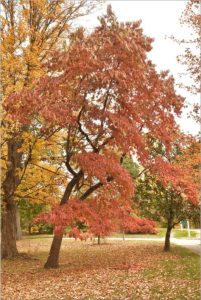
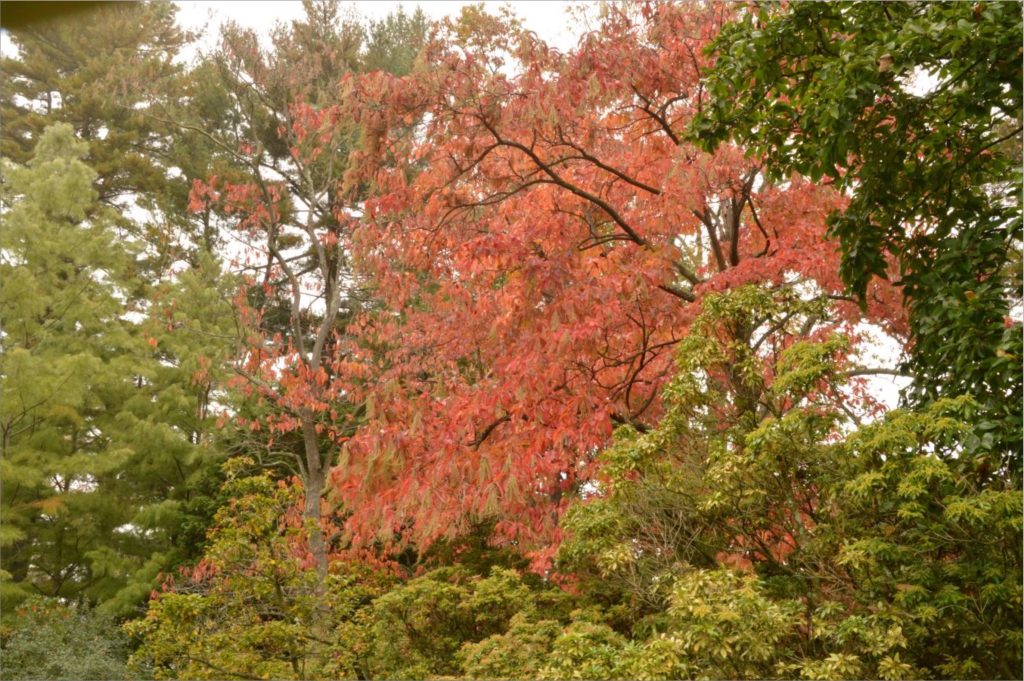
With the onset of November, everyone starts to think about the Holidays and suddenly our focus passes from the colors of autumn to all the Holidays to come. It is unfortunate since November in central New Jersey often features many trees with spectacular fall color. One tree that I consistently find enjoyable for its fall color, yet missing from many a garden is Sourwood, botanically known as Oxydendrum arboreum. A fine specimen at Frelinghuysen Arboretum can be seen at right in October, bedecked in all its autumn glory!
Although Sourwood is rather exotic in appearance, it is actually native to the East Coast of North America, extending from Pennsylvania South to Louisiana. A member of the Ericaceae or Heath Family, it was originally named Andromeda arborea by Carl Linnaeus, since the flowers are deceptively similar to Andromeda polifolia, a plant he discovered in Lapland and initially named in 1732. Sourwood was reclassified as Oxydendrum arboreum in 1839 by the Swiss botanist Augustin Pyramus de Candolle (1778-1841).
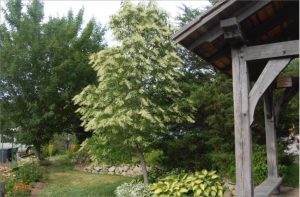
Oxys is Greek for sour, referring to the taste of the foliage which also influenced the common name! Dendron means tree, as in fact does the species epithet of arboreum! Indeed, it is a tree with a pyramidal habit in youth and easily growing to 50’ tall in the wild. However, it grows to a more refined 20-30’ in a garden. The leaves are lanceolate or canoe-shaped, glossy and deep green in color. In June and July many of the branches are tipped with pendulous flower racemes (as seen at left), consisting of clusters of 3 stems stretching to upwards of 10” in length that are covered with small bell-shaped flowers (as seen below right).
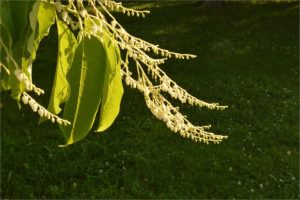
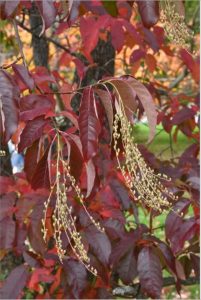
The flowers are white with a faint yet very pleasant scent. As attractive as the summer floral display is to behold, it only gets better come Autumn! In late summer and throughout the fall, the flower structure remains unchanged, but the flowers are replaced by light yellow seed capsules. As fall proceeds, the deep green foliage turns to deep red, providing a dramatic backdrop for the seed capsules. A totally awesome, jaw dropping display as seen below in October!
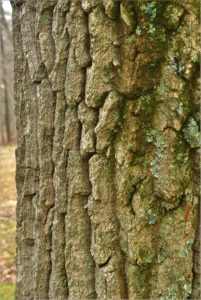
For the winter, Sourwood also has an interesting branch outline. Unusual to most trees, Oxydendrum does not have terminal buds. Rather, the closest lateral bud to the stem apex assumes the role for developing the leader. This creates a rather interesting zigzag branching habit and an interesting winter outline. The drawback to this stem morphology is the tendency for the tree to develop two or more main leaders, referred to as co-dominant branching. This is an inherently weak branching habit and the removal of one of the leaders should be conducted as soon as this habit becomes evident. For those gardeners who relish interesting bark during the winter months, Sourwood also develops very pronounced and deeply fissured bark, as seen below right. Even people that are not really bark fanciers will be found exclaiming over the deep fissures when first introduced to the bark of a mature tree, as seen below.
Sourwood is most commonly found along the Appalachian Mountains in soils that are well-drained and gritty, typical of steep mountain slopes or stream banks. In the garden, it is certainly tolerant of average garden soils, but it has proven to be intolerant of moist soils. I have planted Sourwoods in moist locations only to have the plants languish until transplanted to a drier location, reaffirming their desire for good drainage. Typical of Ericaceous plants, Oxydendrum thrives in acidic soils with a pH range of 3.7 and 6.5, making it an ideal companion for Rhododendrons. In fact, one of the closest genetic relatives of Oxydendrum is the afore mentioned Pieris. It is commonly known as Andromeda and is typically seen in gardens in combination with Rhododendrons!
For the garden, this tree is best used as a small to midsize tree. The biggest challenge is the time required by the plant as it ‘decides’ whether it wishes to be a tree or a shrub! The plant will often seem to pause and contemplate its future when it is 3-4’ tall before it ultimately grows into a tree. This is due to its nature of constantly producing a new leader each spring from a lateral bud along the stem. Over a 35-year period at Rutgers Gardens, I watched a plant slowly grow from a rather unimpressive specimen of 4’ while I was a student into a to 25’ tall by 15’ wide showstopper! If given room, the plants will expand into a more globose or rounded habit with time, as seen at Chanticleer Gardens in the image below.
From a design standpoint, in its early years Sourwood is best used where an exclamation point is of need or where a narrow plant is required to soften architectural details. In time, it clearly grows into an attractive broad spreading tree with a rounded crown. For the unknowing gardener, its appearance as a young containerized plant at a Garden Center does not belie its appearance in 20 or 50 years later in the Garden! From a plant lover’s standpoint, its offerings of summer blooms with their attractive fragrance, blazing autumn color with contrasting seedcapsules and the ensuing attractive winter habit, Sourwood is a tree that no garden should be without. Indeed, this ‘Sour’ plant can provide many ‘Sweet’ offerings to the garden and the gardener!
Bruce Crawford
Manager of Horticulture, Morris County Parks Commission