The sunny beds flanking the entrance to the Haggerty Education Center have been planted differently this year with a “hot” combination of tropical plants, including Aechmea blanchetiana ‘Hawaii” (Bromeliad), deep red Coleus spp, bright orange Marigolds (Tagetes) and delicate Tassel Flowers (Emilia spp). It makes for a striking arrangement, especially when planted in front of the dark green hedge behind. Visit and see for yourself!
Picture credits: Margery Ennist.
Achmea Blanchetiana Hawaii
This is the Friends of The Frelinghuysen Arboretum’s Photo Gallery. Click on the title of one of the albums below to open it where you may then browse the pictures. To receive photos regularly, sign up for our weekly email blast by clicking here.
We welcome pictures from all our friends and visitors — send any you would like to see here to webmaster@arboretumfriends.org.
Several weeks ago, we featured the lovely Koelreuteria paniculata ‘Rose Lantern’ tree. The delicate yellow flowers have transformed into green “lanterns”; eventually these will dry and hold the next generation’s seeds. Isn’t nature amazing?
A pretty Crapemyrtle (Lagerstroemia cv. ‘Acoma’) is blooming along the driveway as you come up from Hanover Avenue, its delicate, crinkly, white flowers floating above the foliage like soft little clouds. The attractive, exfoliating bark offers winter interest once the foliage and flowers have fallen.
Regardless of where my travels may take me, I am always drawn to the plants and flowers typical of the area I’m visiting. A few special ones from my recent trip to Portugal:
High above the Atlantic Ocean at Cabo da Roca (the westernmost point in Europe) I found a feathery yellow flower blooming among its succulent-like leaves, probably a Delosperma (Ice Plant).
In a seaside town, lining the street, the striking red bottlebrush flowers of the Pohutukawa metrosideros excelsa trees (New Zealand Christmas Tree) were putting on quite a show.
Bougainvillea could be found everywhere, draped over walls, fences and buildings and covered in masses of papery magenta flower bracts.
A day trip to the Douro Valley was a wonderful experience; the hillsides of this World Heritage designated area are covered in grapevines as far as the eye can see. The harvest will begin in September followed by the production of the world famous Port wines of Portugal.
Thanks to frequent contributor, Steve Kanan, for another batch of lovely pictures. He said he enjoyed normal weather so much that he followed up his morning visit with another in the afternoon.
Don’t miss out on summer at the Frelinghuysen — visit the gardens soon.
There are many varieties of Hibiscus plants; two that are currently in bloom at the Arboretum are Hibiscus moscheutus and Hibiscus syriacus.
Hibiscus moscheutus (Swamp Rose Mallow) is a herbaceous perennial that produces dinner plate sized flowers. The plants can reach 3-7 feet tall by 2-4 feet wide. New growth is slow to emerge in spring, but grows quickly thereafter. Hibiscus moscheutus cv. Kopper King is a pretty shade of pink with a dark pink throat. A bright red Hibiscus moscheutus (possibly ‘Lord Baltimore’) is blooming nearby.
Hibiscus syriacus (Rose of Sharon) is a close relative of H. moscheutus. A native of eastern Asia, it is a vigorous, upright, vase-shaped, multi-stemmed, deciduous shrub which grows to 8-12 feet tall. Currently in bloom at the Arboretum are a white flowered plant, Hibiscus syriacus cv. Diana and the blue flowered H. syriacus ‘Blue Bird’.
Several other varieties are also in bloom, why not visit and check them out for yourself?
Shades of red, orange and yellow are considered “hot” colors; in the garden, they serve to brighten up a spot, highlight an area and/or provide a focal point to lure you in for a closer look.
The arbor at The Frelinghuysen Arboretum holds a large Trumpet Vine (Campsis radicans), covered at this time of the year with big orange flowers. The Trumpet Vine is a vigorous, deciduous woody vine growing to about 33 feet long, with shiny, dark green, pinnately compound leaves. The flowers are each about 3.5 inches long, trumpet shaped and lacking in scent. After flowering, a six inch long seed capsule forms, dries and splits releasing hundreds of thin, brown, paper-like seeds. It is native to the Eastern United States..
Another name for the plant is Hummingbird Vine because the flowers attract these tiny, jewel-like summer visitors. The vine also attracts a variety of other creatures: Birds nest in the vine and moths, bees, flies and ants feed on the nectar.
A variety of vegetables and fruits are grown in the Barkman Vegetable Garden and this year there is a large bed of Sunflowers (Helianthus) growing against the fence, providing a nice, bright sunny yellow show. Sunflowers are native to the Americas and are said to symbolize long life and lasting happiness.
An interesting fact about Sunflowers is that they track the sun (heliotropism). At night, Sunflowers face east, anticipating the sun’s return and track its progress throughout the day. They do this until they get old and stop moving.
The gardens at The Frelinghuysen Arboretum hold a large variety of hot blooming plants, visit soon and discover them for yourself!
Blue in the garden can create a cooling, soothing, restful atmosphere. This can be achieved by using flowers, foliage, garden ornaments, etc., in all shades and hues of blue. The Blue Garden in front of Matilda’s Cottage contains all sorts of blue flowered plants, from annuals such as Fan Flower (Scaevola) to perennials such as Balloon Flower (Platycodon grandiflorus) and the airy, delicate flowers of Love-in-a-Mist (Nigella damascena). Blue metal benches and a tall blue tuteur providing a climbing structure for a Clematis vine, complete this garden.
Visit this lovely garden room soon, sit on one of the blue benches and watch the bees and butterflies as they hover around the many flowers in the garden.
Today we’re featuring the lovely Koelreuteria paniculata ‘Rose Lantern’. This is a dense, rounded, deciduous tree which grows to a height of between 30 and 40 feet with an equal or greater spread. It has pinnate leaves that emerge reddish in the spring, mature to a bright green and turn yellow in the fall. Airy panicles of delicate golden yellow flowers bloom in summer followed by dramatic, rose-pink, bladder-like fruits in the fall.
Known as the Golden Rain Tree, the Arboretum’s specimen can be seen on the left at the end of the first parking bay as you come up the driveway from Hanover Avenue. Make a point of visiting it soon and come back to see the bladder-like fruits in the fall!
Here are just a few of the unusual plants used in this year’s entrance gardens to the Haggerty Education Center. Plantings made possible by a grant from the Friends of The Frelinghuysen Arboretum.
Talinum paniculatum ‘Jewels of Opar’: A succulent subshrub commonly known as Fame Flower or Pink Baby’s Breath. The bright lime green leaves and small pink flowers held atop thin dark stems are a lovely addition to the garden bed. The plant is native to much of North and South America and the Caribbean.
Mangave ‘Silver Fox’: A hybrid plant that offers the attractive structure of Agave and the faster growth and colors of Manfreda. It has broad, toothed blades with a thick waxy coating and can tolerate more water than other succulents.
Berkheya purpurea ‘Zulu Warrior’: A deep rooted and drought tolerant South African native perennial. It has single, smoky lavender flowers with dark purple centers held atop flower stalks that can reach 3 feet in height. The plant has spiky silvery green leaves and makes an excellent cut flower.
Ptilotus exaltatus ‘Joey’: A compact, short-lived herbaceous perennial with large, long lasting, conical spikes of feathery flowers. Attracts bees and butterflies and is a good cut flower.
Talinum Jewels of Opar
Berkheya Zulu Warrior
Mangave Silver Fox
Mangave Silver Fox
Ptilotus Joey
Ptilotus Joey
Click on an image to enlarge. Picture credits: Margery Ennist.
On Wednesday, June 14 forty travelers joined the Friends on a bus trip to Andalusia Historic House and Gardens and to Jenny Rose Carey’s garden, both in Pennsylvania.
At Andalusia we were broken up into groups of ten and treated to an in-depth history of the house by very knowledgeable docents. Following the house tour we were free to tour the extensive gardens on our own; from the White Garden, to the Green Walk, Rose Garden, Long Border, the Graperies, and much more, the grounds are a delight to the senses. Andalusia sits on the banks of the Delaware River, so the River Walk was a great visual experience.
Photos are of the Graperies, where fine table grapes are raised, and the adjacent formal garden as well as the Grotto on the River Walk at Andalusia, both courtesy of Gerry Papalardo. The Andalusia Library photo is by Margery Ennist.
Following a box lunch picnic as we sheltered from the brief rain showers, we were on to the garden of British plantswoman extraordinaire, Jenny Rose Carey
Jenny and her family greeted us warmly to Northview Gardens as we pulled up on the bus. Her garden is a series of 31 distinct areas on 4-1/2 acres, mostly informal and a little bit wild, but a wonderful experience as you never knew exactly what you would encounter as you turned a corner! We were shown the Cutting Garden, a Teapot Garden, a lovely waterfall and pond area, a covered outdoor dining area, a Hugelkultur (“hill culture”) area where Jenny piled up a bunch of old rotting logs, covered them with old wood chips, soil and leaf mulch creating a planting medium. Over the years she has turned this hill culture into a fertile and thriving garden patch where flowers are flourishing.
Our visit ended with a proper cup of tea and fond farewells.
Photos are of Jenny Rose Carey framed by lovely Poppies, courtesy of Daryl Savage, the waterfall garden and Teacup Garden, both courtesy of Margery Ennist.
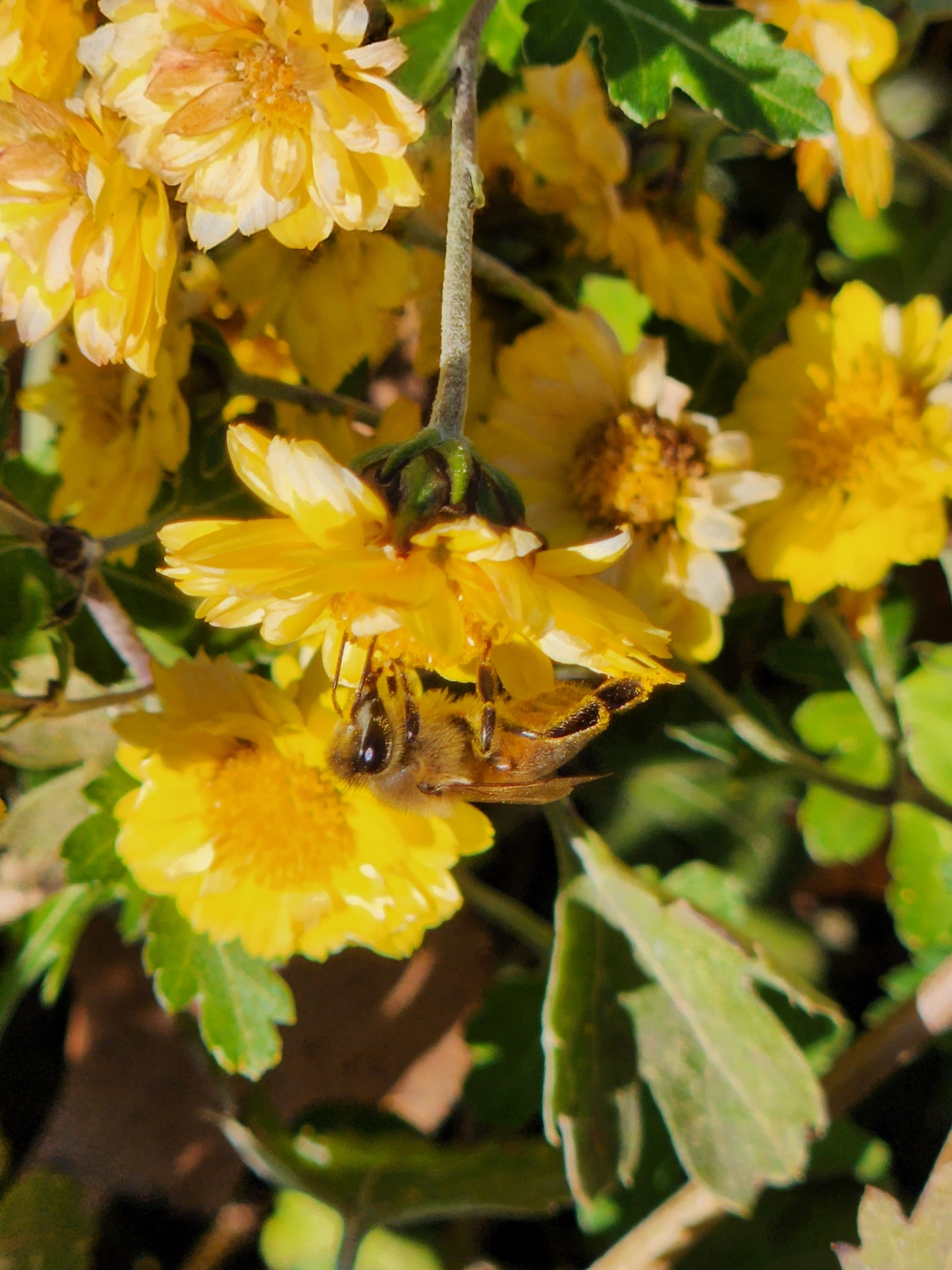
The plants, the weather, the macro lens all called Steve Kanan back for a Sunday Saunter yesterday. We are the lucky recipients of these beautiful photos. Thank, Steve.
We finally got some much-needed rain and the gardens at the Arboretum were looking fresh and revived as a result.
The Daffodils and Tulips in the Haggerty Education Center entrance gardens have been replaced with a variety of annuals, including a spectacular Digiplexis, a cross between Digitalis purpurea (Foxglove) and a Digitalis relative native to the Canary Islands called Isoplexis. Here in New Jersey this plant will behave as an annual, blooming from Summer into Fall and growing to a height of about three feet. These gardens are made possible by a grant from the Friends of The Frelinghuysen Arboretum.
The cone-shaped clusters of white flowers on the Oakleaf Hydrangea between the Haggerty Education Center and Matilda’s are putting on quite a display. The white flowers will gradually turn light pink over the summer while attracting pollinators and birds.
I was drawn to the pond in front of Matilda’s cottage by the loud croaking of a male frog. This little pond is a busy ecosystem, populated by a number of frogs swimming about and behaving in a most frisky manner! Nature at her finest!!!
Steve Kanan sent these images from a visit to the Arboretum at lunchtime yesterday. Clearly the plants are well on their way to their grandest summer display.
Thanks, Steve, for sharing the beautiful pictures.
White and pale orange captured my attention today as I strolled through the various gardens at the Arboretum. A huge, very fragrant flower on the Magnolia grandiflora cv. Edith Bogue (Southern Magnolia Cultivar), the large trumpet shaped flower on a Brugmansia (Angel’s Trumpet), the spidery white flower on the annual Cleome hassleriana (Spider Flower) and the light orange flower on the Campsis radicans (Trumpet Creeper Vine) climbing over the arbor leading into the Haggerty Education Center. Plan to visit soon!
A gorgeous warm, sunny day with clear blue skies and abundant white fluffy clouds floating overhead. The cottage next to the Haggerty Education Center is surrounded by many different plants and flowers. Some of the flowers blooming today: a lacy, light blue Nigella damascena (Love-in-a-Mist), an Oakleaf Hydrangea, a spike of Stachys cv. Summer Romance (Betony) being visited by a pollen covered bee, and a bright yellow Coneflower (Echinacea).
On hand for the day were members of the North American Butterfly Association, as well as Lorette Cheswick, horiculturist and beekeeper, Jim Walker, owner of the Wild Birds Unlimited store in Denville, Gail DiDomenico, a Master Gardener, popular local speaker and plant expert, and members of the Home Garden Club of Morristown. Helping out were Master Gardener volunteers, teen volunteers, and of course, members of the Friends of the Frelinghuysen Arboretum.
A new batch of closeups from contributor, Steve Kanan who says, “Relaxing with the macro early Friday evening after a long week. Thank you Frelinghuysen for being there.”
Cloudy and muggy with rain in the forecast. Nevertheless, lots in bloom in the gardens. A sea of Callirhoe involucrata (Purple Poppy Mallow) gently swaying in the breeze, a tall Verbascum thapsus (Common Mullein) blooming against a Blue Spruce in the background, the complex, scented flowers of Asclepias syriaca (Common Milkweed), the fluffy white flowers of Sambucus canadensis cv. Maxima (American Elderberry) and the tall, feathery, pale yellow flowers of Thalictrum flavum subspec. glaucum (Meadow Rue).
There used to be a set of stairs going up to the patio on the side of the Haggerty Education Center. Several years ago, the patio was renovated, the stairs were eliminated and new railings were installed; there is a handicapped accessible ramp to the patio, as well. The four lamp posts that were on the sides of the steps were left. The following spring, new plantings were installed where the stairs were; at first they really didn’t look like much, but as the plants became established, grew and spread, the area turned into an attractive garden visible as you come up the driveway at the Arboretum.
The plantings are a combination of Prunus laurocerasus cv. Schipkaensis, Oakleaf Hydrangeas, Epimedium x versicolor ‘Sulphureum’, Hosta sieboldiana cv. Elegans, a lovely purple variegated leaf Iris, a perennial Geranium (Wargrave Pink, perhaps?) and some Columbines. Enjoy the photos.
A bit muggy and cloudy at the Arboretum today, but we are expecting rain. As always, much to see and enjoy, such as the intricate, perfectly round seed head of an Allium flower, the beautiful, but toxic, flowers of a potato plant (Solanum tuberosum, in the Nightshade family) and a stalk of Phlomis tuberosa flowers (Jerusalem Sage, in the Mint family) working their way up the stem in groups of pretty lavender flowers.